

What is Sales Cycle Optimization?
Sales cycle optimization is the disciplined removal of structural friction from the stages a deal moves through – from first touch to closed-won – to shorten cycle time, lift win rates, and make revenue more predictable. Most teams treat a slow cycle as an effort problem and respond with more activity, more tools, or more headcount. That rarely works, because the slowdown is usually structural: friction buried in the motion itself, not a lack of hustle.
The distinction that matters: activity is not flow. A pipeline can look full and busy while revenue moves through it slowly and unpredictably. Optimization targets the flow – the speed and reliability with which qualified deals convert – rather than the raw volume of calls, emails, and meetings on top of it.
Why Do Sales Cycles Stall?
Sales cycles rarely stall for one dramatic reason. They stall because friction compounds quietly across the motion, and because the market got harder while the sales system stayed the same:
11+
stakeholders in the average B2B deal
7.2 mo
typical enterprise sales cycle length (218 days)
60%
of rep time swallowed by admin & tool friction
The average B2B deal now involves more than eleven stakeholders, and complex enterprise cycles have stretched to an average of 218 days (Forrester, 2026). Meanwhile, sales reps are drowning in internal friction, spending 60% of their week on administrative tasks and tool management instead of active deal progression (Salesforce, 2026).
Further, if they’re using old playbooks and onboarding programs, teams are selling to a buying environment that no longer exists. In fact, 83% of B2B buyers now fully define their purchase requirements before ever speaking with a sales rep (6sense, 2025). The result is a cycle that drags out, but not because your reps are weak; because your sales cycle is entirely disconnected from how your sellers are having to sell.
What is Sales Process Optimization?
Sales process optimization involves refining various stages of your sales process to make it more effective and better aligned with buyers’ decision-making. It also consists of pinpointing what is working, removing what isn’t, and creating a more efficient path from lead to close. Sales process optimization includes lowering sales cycles, improving conversion rates, offering your representatives with better data, and delivering faster revenue.
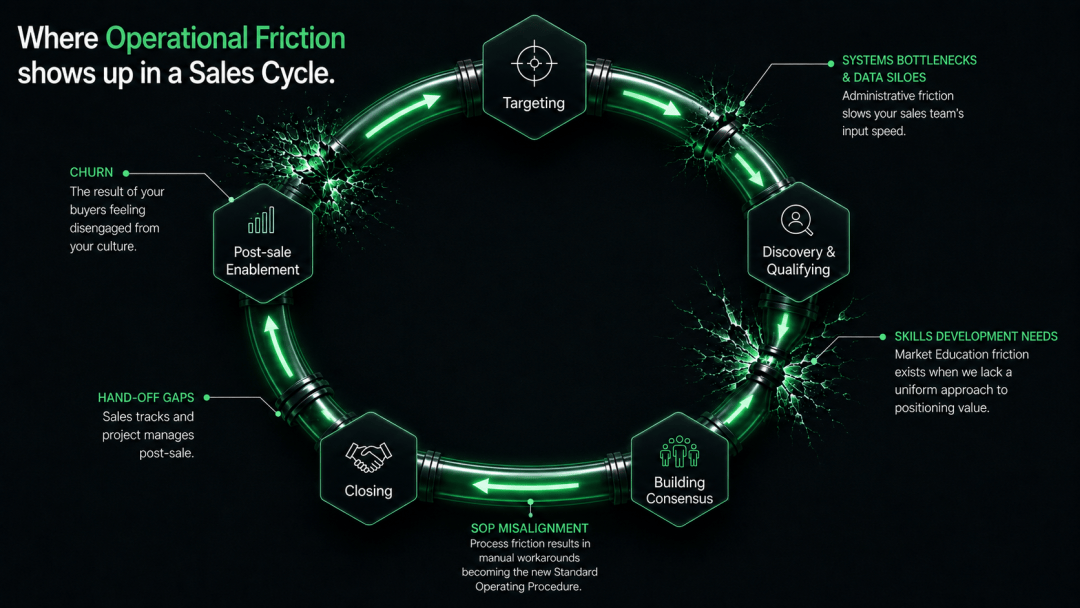
The Four Places Friction Hides in a Sales Cycle
When Elemental optimizes a sales cycle, we look in the four places friction reliably accumulates – and where dashboards almost never reveal it:
Stall points
Where deals slow, drift, or die inside the actual cycle - not how the CRM reports the stage, but how the deal (and revenue) truly flows.
Execution gaps
What your strongest reps do differently, and where the rest of the team breaks from that standard either by default or by design.
Message-to-market reality
How buyers interpret your value proposition versus how marketing, and in some cases leadership, assumes it lands.
Managerial and process friction
Where handoffs and standard operating procedures make maintaining consistent performance harder than it should be. When this handoff process is under-enabled, Customer Success is forced to deploy excessive resources to patch up misaligned expectations.
In the modern era, it costs anywhere from 5 to 25 times more to mechanically fix a fractured customer experience than it does to acquire and deliver on a properly qualified one (Harvard Business Review, 2024).
How to Optimize Your Sales Cycle (the Elemental Method)
Optimization only sticks when it follows diagnosis. Elemental runs it in three steps, in this order:
Quantify the Friction
Start with the FrictionFILTR™- a free, stat-backed audit that returns your Pipeline Friction Score, an estimate of the annual revenue that friction is costing you, and the top three likely structural constraints. This takes about five minutes and gives you a credible baseline before you spend anything.
Diagnose the Constraints
The Diagnostic is a fixed-fee, 10-business-day revenue forensics sprint. It maps how revenue actually flows through your system, pinpoints the top five constraints suppressing it, and delivers a Revenue Remediation Blueprint with the right order of operations – your 90-day action plan.
Remediate What Matters Most
Precision Sales Enablement then installs the fixes tied directly to the findings - qualification gaps, process correction, handoff revision and repair, messaging consolidation and alignment, and/or managerial execution support - in the sequence that restores flow fastest.
This is the core difference between sales cycle optimization and generic sales training.
Training assumes the reps are the problem and prescribes a fix. Optimization assumes the operational friction is the crux of the issue first – then verifies it (and any skills gaps) with evidence before changing anything.
Frequently Asked Questions
How long does it take to optimize a sales cycle?
The initial diagnosis is fast: the FrictionFILTR™ takes about five minutes, and the full Diagnostic is a fixed 10-business-day sprint. Remediation timelines depend on the constraints found, but the Blueprint is built to produce results in the following 90 days by fixing the highest-impact issues first.
Is sales cycle optimization the same as sales enablement?
It is a more precise form of it. Traditional enablement often starts with content and training. Sales cycle optimization starts with diagnosis – finding and removing the specific operational friction slowing deals – so any enablement that follows is targeted at a proven root cause rather than a guess.
How do I know if my sales cycle has hidden friction?
Common signals: the pipeline looks healthy but forecasts still miss, deals stall without a clear cause, retention and win rates are inconsistent, and the same few reps continue to carry the number.
The real danger of ignoring these signals is that you are entering the deal entirely too late.
94% of buying groups fully rank their preferred vendors before they ever initiate contact with sales – and they ultimately buy from that day-one favorite 77% of the time (6sense, 2025).
If your sales system is siloed, you are winning only the low-margin scraps where you have to discount heavily to pivot a pre-convinced buyer. This ends up burning massive organizational resources trying to fix a bad fit rather than simply delivering on a flawless expectation.
The FrictionFILTR™ quantifies it in about five minutes.
Contact Us to Improve Your Sales Process Optimization
If your sales cycle is dragging and you cannot point to exactly why, start by quantifying it – before you add activity, tools, or headcount (again).
→ Get your Pipeline Friction Score (free, ~5 min): theFrictionFILTR™.paperform.co
→ Or talk to us directly: info@elementalsales.org | (857) 526-3796